[1] Beginning in 2013, Italy introduced a National Strategy for Inner Areas (Strategia Nazionale per le Aree Interne), aimed at marginal and peripheral localities requiring targeted territorial revitalization policies. The classification of an ‘inner area’ depends on several criteria: accessibility to primary public services and infrastructure, proximity to public healthcare facilities, the possibility of accessing secondary education, and the availability of mobility infrastructures. The major challenges facing these areas include socio-economic marginalization and depopulation.
[2] This refers to the ‘Colere–Lizzola’ project which, according to its private promoters—supported by substantial public funding—is proposed as a tool to revive the local economy and counter depopulation. This «assault on the highlands» to use the expression of journalist Andrea Siccardo, who reported on the issue for Altreconomia, would materialize through the expansion of the local ski area, involving the construction of new lifts and the excavation of a tunnel between Val Sedornia and Val Conchetta, two wild, still uninhabited zones.
[3] Bonicelli was the engineer who supervised the work of the Barisella Mining Consortium in the post-war years, when Marshall Plan funds financed the industrialization process of the newly born Italian Republic, then a strategic ally of the United States in the midst of the Cold War. The archaeological park is accessed through the Gaffione mining site, located a short distance from the town center of Schilpario.
[4] Silicosis, along with tuberculosis, was one of the defining diseases of the Second Industrial Revolution, marked by heavy industry, metalworking, and steel production. Until the 1930s, there was no real legislation protecting those working in mines. The issue was first addressed technically in the late nineteenth century with the introduction of a water-powered drill that moistened the rock surface during drilling, reducing the production of ‘heavy’ dust. However, its international adoption remained discretionary, and silicosis itself was barely recognized as an occupational disease.
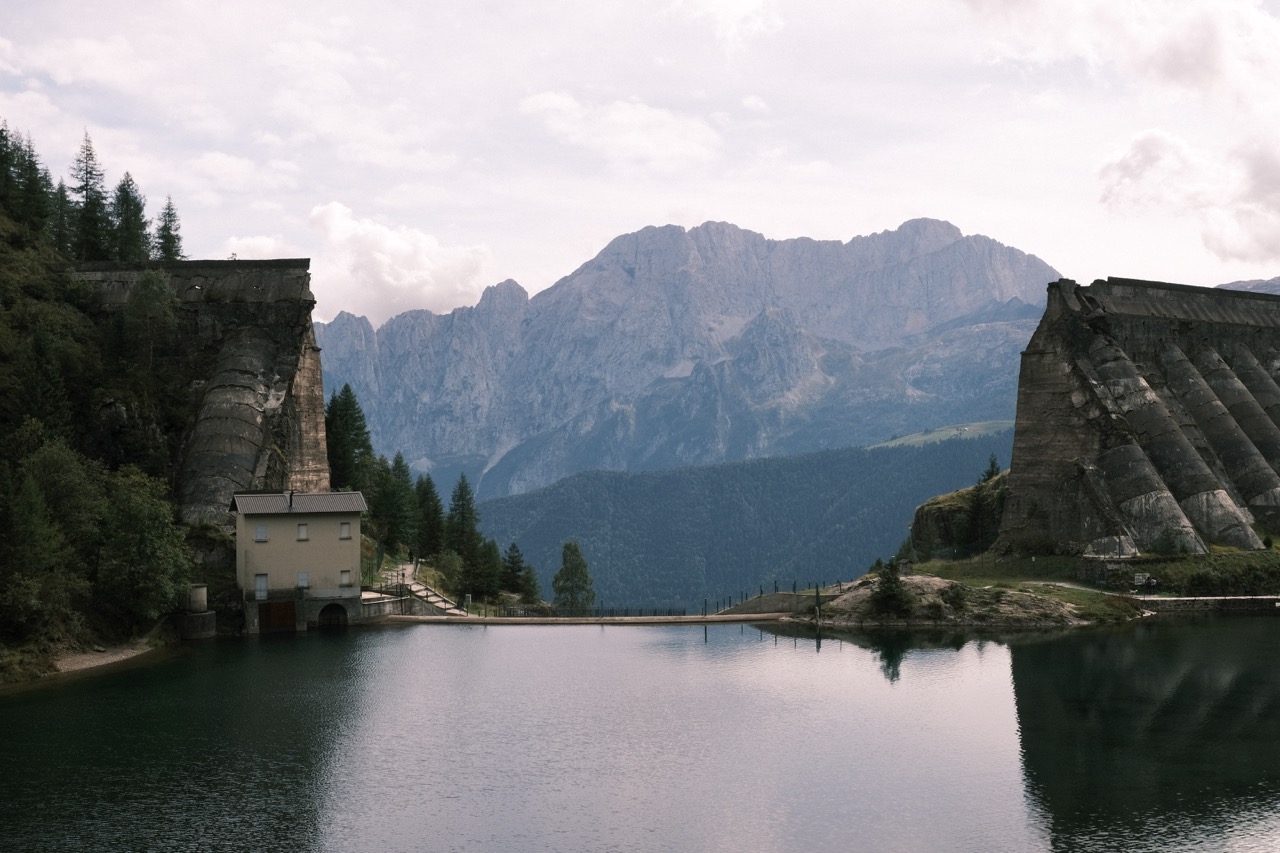
The Presolana massif photographed from inside the Gleno gorge – Photograph by Francesco Danesi della Sala
Once you cross the small rise of the Pass, the road briefly levels out into a gentle descent, flanked by shy mountain houses and silent meadows. A sudden bend seems to hint at the unexpected. One has to brace for it, because from here the asphalt drops sharply along the eastern face of the Presolana: hairpin turns plunging into the void, and the Orobic massif looming like a colossal wave of jagged ridges and marble shadows. Down in the depths of the slope lie the fearsome ravines of the Via Mala, the ancient path that once clung precariously to the Dezzo River, connecting Val Camonica to Val di Scalve. Reaching the valley floor, you enter Dezzo di Scalve, and the road begins to climb again, soft gradients cutting through lively woodland, which eventually open into the entrance of the village. Vilminore di Scalve sits at the threshold of the valley that bears its name; for centuries it has been its central reference point, gazing westward toward the vast amphitheatre of the Presolana and southward toward the vertiginous course of the Dezzo. Behind it, concealed by Pizzo Pianezza, lies the Belviso Pass, from which the Gleno stream descends. It is said that the name Gleno derives from the Gaelic glen, meaning ‘narrow glacial valley’. Yet here, the name carries a meaning far beyond topography. In Val di Scalve, Gleno is a deep wound.
The Village
The village of Vilminore, of Roman origin, coils tightly around its main street, which winds its way uphill, crossing the piazza of the Bar Sport before reaching the old Palazzo Pretorio, built in 1375 and now home to the local mountain community authority. Just beyond, Marianna is waiting for us, standing by the wide steps of the Arch presbyterial Church, whose massive bell tower reaches nearly seventy metres into the air. «Welcome!» she calls out warmly, inviting us into her family’s accommodation, recently renovated—she explains—to host travellers and curious visitors passing through. «Oh, you’re researchers, very good» she remarks, quick to comment on the purpose of our visit. Then she adds: «Things aren’t easy around here, but it’s important to keep moving, to come up here, bring people here, help them discover this territory».
A little later, we meet Stefano Albrici, the deputy mayor. We find him at the municipality’s temporary headquarters on the southern side of the village, near a small mechanical-textile workshop. Along the way, we pass a large sand football field overlooking—almost like a balcony—the imposing silhouette of the Presolana. «I’ve always been passionate about historical research» Stefano tells us, «and genealogy too, since my great-grandfather emigrated to Australia». He invites us inside the village’s multipurpose centre. In the dim entrance hall, we notice a sizeable architectural model. As we approach it, Stefano continues: «Since 2023 I’ve been the President of the Committee for the Gleno Centenary. We’ve tried to bring together our village with all those across Val di Scalve and Val Camonica, in remembrance of what happened. Here it is» he says, moving closer to the model, «this was the dam before it collapsed. It was beautiful in a way».
The Dam
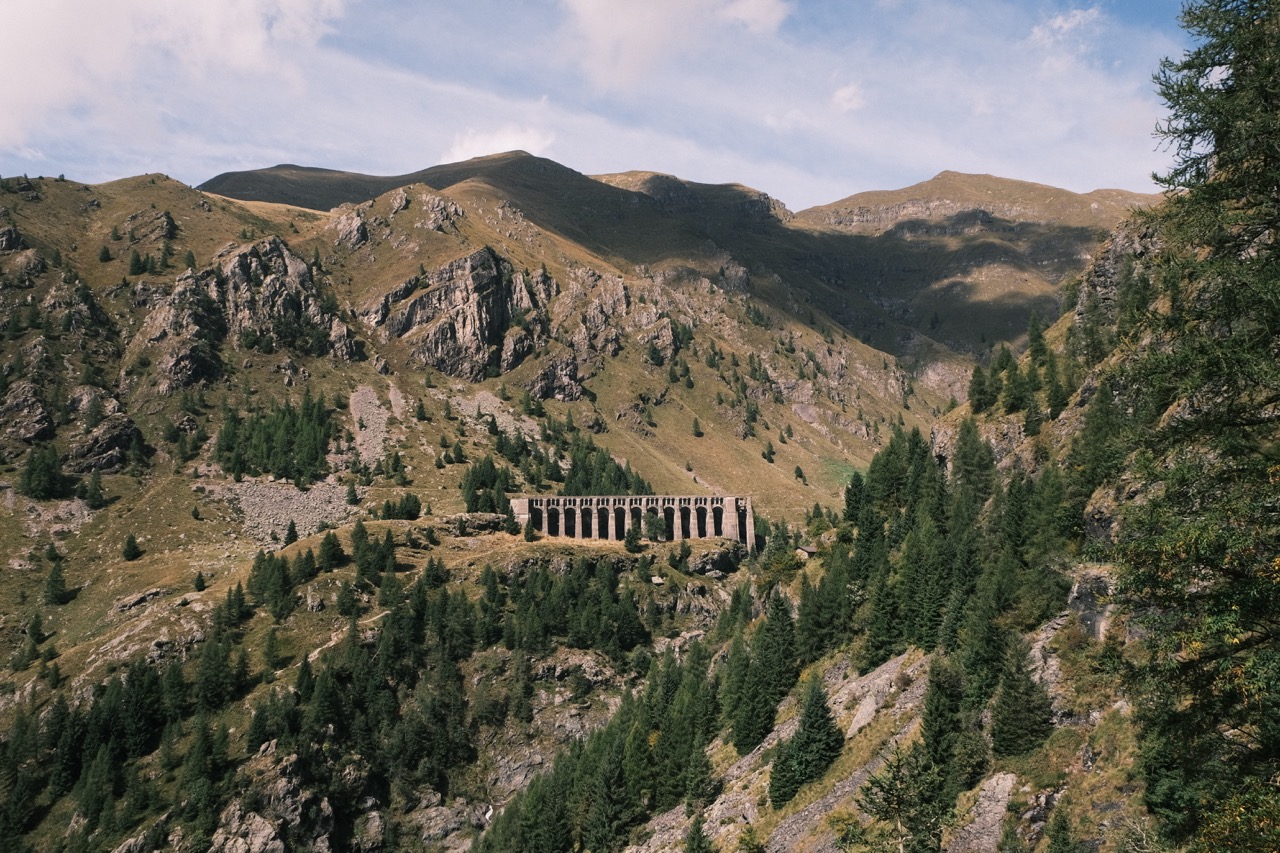
Trail 411 begins in Pianezza, a small hamlet perched just above Vilminore. The path turns steep almost immediately, leaving behind a few sunlit meadows before entering a dense thicket that climbs sharply, zigzagging alongside a large water conduit until it reaches 1,500 metres of altitude. From here on, the trail softens, levelling out for a short stretch beneath the last shaded branches of the forest. Suddenly, however, the gaze is overwhelmed by the biting brightness of the sky. The valley and its mountains stand magnificent on all sides, and the path becomes an irrational challenge carved into the sheer rock, a continuous precipice running along the left bank of the torrent. At last, the arches appear in the distance, and the fracture in the gorge: a dark, torn gate ripped open by the force of water. The dam, with its striking multi-arch architecture, looks almost like a spectral mirage — How did they even build it up here? we ask each other, incredulous. Absurd, we repeat. In the distance, the rumble of a helicopter grows louder.
The ruins of the Gleno dam peeking out from behind the ridge along trail CAI 411 – Photograph by Francesco Danesi della Sala
The story of the Gleno Dam is entwined with the broader history of Italian modernization in the early twentieth century, and more specifically with the tangle of private and state interests that shaped many development projects across the peninsula. In the case of the dam, its construction was promoted by the Viganò family, leading figures in Milan’s textile industry. The structure was intended to supply the Viganòs’ factories with abundant and, above all, inexpensive electricity. In 1919, after obtaining the necessary permits from the Ministry of Public Works, construction began. «In 1919 they started excavating the rock. In 1920 they built the first section, because the initial design was for a gravity dam, essentially a massive wall whose sheer weight counteracts the pressure of the water behind it» explains Sergio Piffari, one of the foremost local historians of the disaster. «But then they changed the design during construction, which is not exactly regular practice — it was the only dam in the world built with a double system. And in ’21 they began building the arches and the pillars. The work was completed in October 1923. The dam filled for the first time on 15 October, 1923. And on 1 December, it collapsed».
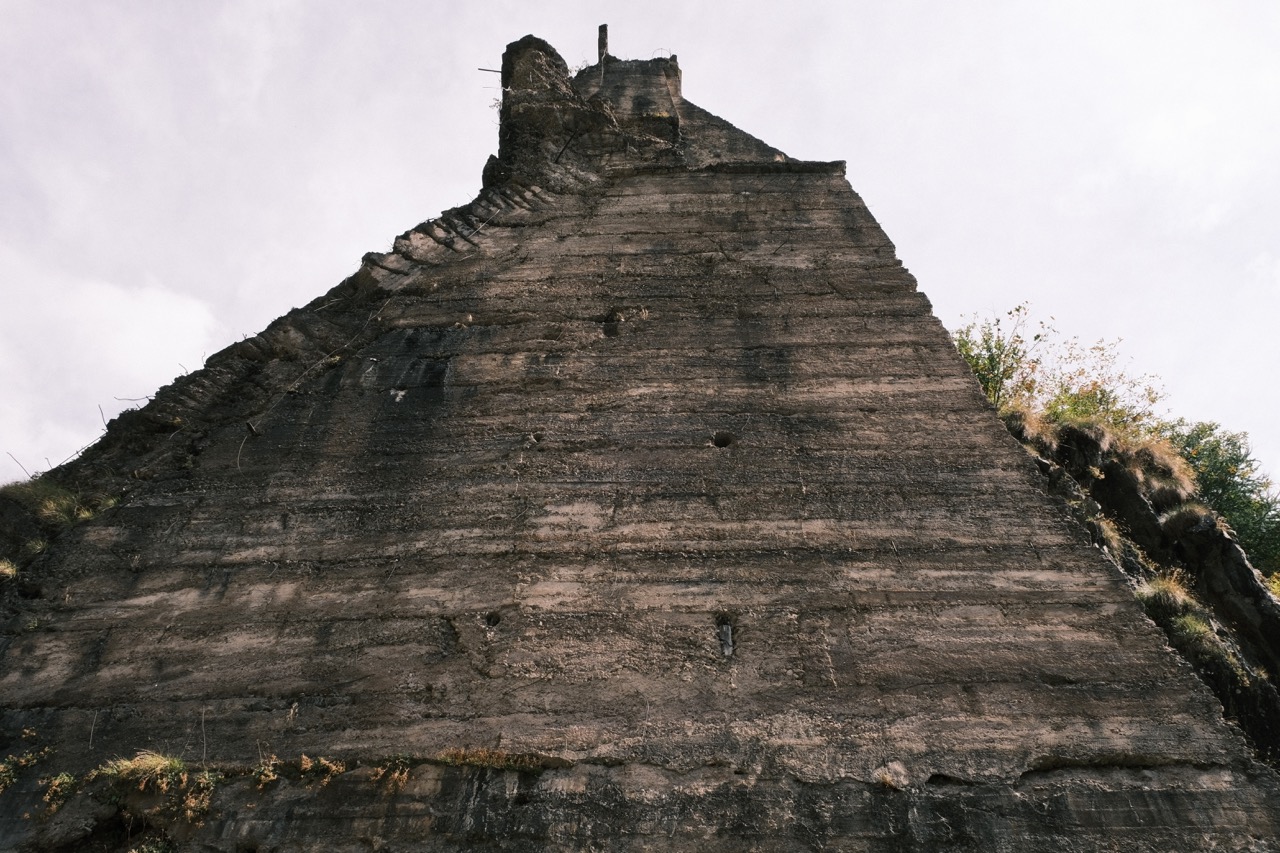
The remains of the breach in the dam, shattered by the torrent of water that swept away eighty metres of wall – Francesco Danesi della Sala
In the moments following the structural failure, six million cubic metres of water tore away eighty metres of the wall, plunging into the valley and sweeping away the villages of Bueggio, Dezzo, and Angolo, before rushing toward Corna di Darfo, and finally crashing into Lake Iseo. The number of victims—though never fully confirmed—was 356. The cause of the collapse, meanwhile, was not difficult to identify: beyond engineering negligence and unchecked revisions to the design, the quality of construction was the most problematic factor—an issue well known to the local labourers. In Val di Scalve, men, women, and children alike were indiscriminately recruited for the most exhausting tasks, from tunnelling to transporting sand. The structural works, by contrast, were entrusted to piece-rate workers brought in from outside. «When local labourers noticed that things weren’t being done properly, because the others were rushing and not doing the work the way it should have been done, they didn’t complain, out of fear of being fired» notes Sergio. «The dam», he continues, «was built on rock that’s not the same as the encasing formation, which is solid. The rock in the centre is porphyrite, more fragile. A dam shouldn’t have been built on it». Then, hesitating for a moment, he adds: «Among the various contributing causes, there’s also the possibility of sabotage with explosives». A hypothesis supported by two expert reports, both of which did not rule out a detonation at the site where the initial fracture occurred. «When I was young, people here used to say that someone from the valley, since the dam was a threat hanging over their heads, wanted to blow the valve to empty it. But instead of emptying it, everything went» Sergio recalls, before turning to the legal proceedings that followed, beginning with the first trial in 1925. Engineer Santangelo, the designer, and Virgilio Viganò were both sentenced to three years and four months in prison. All others were acquitted. Two years of their sentence were later pardoned. In the Milan appeal trial, both were eventually acquitted—Viganò because he had died, and engineer Santangelo due to insufficient evidence. Throughout the proceedings, Viganò boasted that he had built the dam at half the expected cost: this, he insisted, was the philosophy his father had instilled in him.
The Mountain
Giampietro smiles under the canopy of the kiosk, his sunglasses reflecting the small lake in the gorge below the dam. «It’s wonderful to work here. It’s the best place in the world» he says as we sip coffee and grappa. «I have to carry everything up by hand, it’s tough. Every day I come up with my donkey, Glen. We load up: what he can carry, and what I can carry». Over the course of a year, he reckons, he climbs to the dam more than two hundred times. We fall silent for a moment, our eyes swallowed by the void carved into the dam, even more unsettling now that we are looking at it from inside the gorge. The dull drone of the helicopter continues to echo through the Alpine basin. «It’s right to remember» Giampietro says when we ask him about the disaster, «but it’s also right to live». Because the past, in the end, does not exhaust the meaning of a community, nor of an entire valley. All the more so because life in the mountains, in these so-called inner areas[1], is entangled in a present marked by chronic social, demographic, and economic problems—above all depopulation. «Someone from outside, I think, could never live in Val di Scalve. Too many gaps in services, things you take for granted in the city, we don’t even know they exist here» explains Giampietro, who is nonetheless keen to underline his pride of origin: «Mountain people are used to working harder, we do tougher jobs». From his perspective, the real issue is the lack of recognition of local specificities by institutions focused solely on urban areas. «Abandoning these territories would be a loss for city dwellers too» he warns, serving drinks to a couple of Chinese tourists.
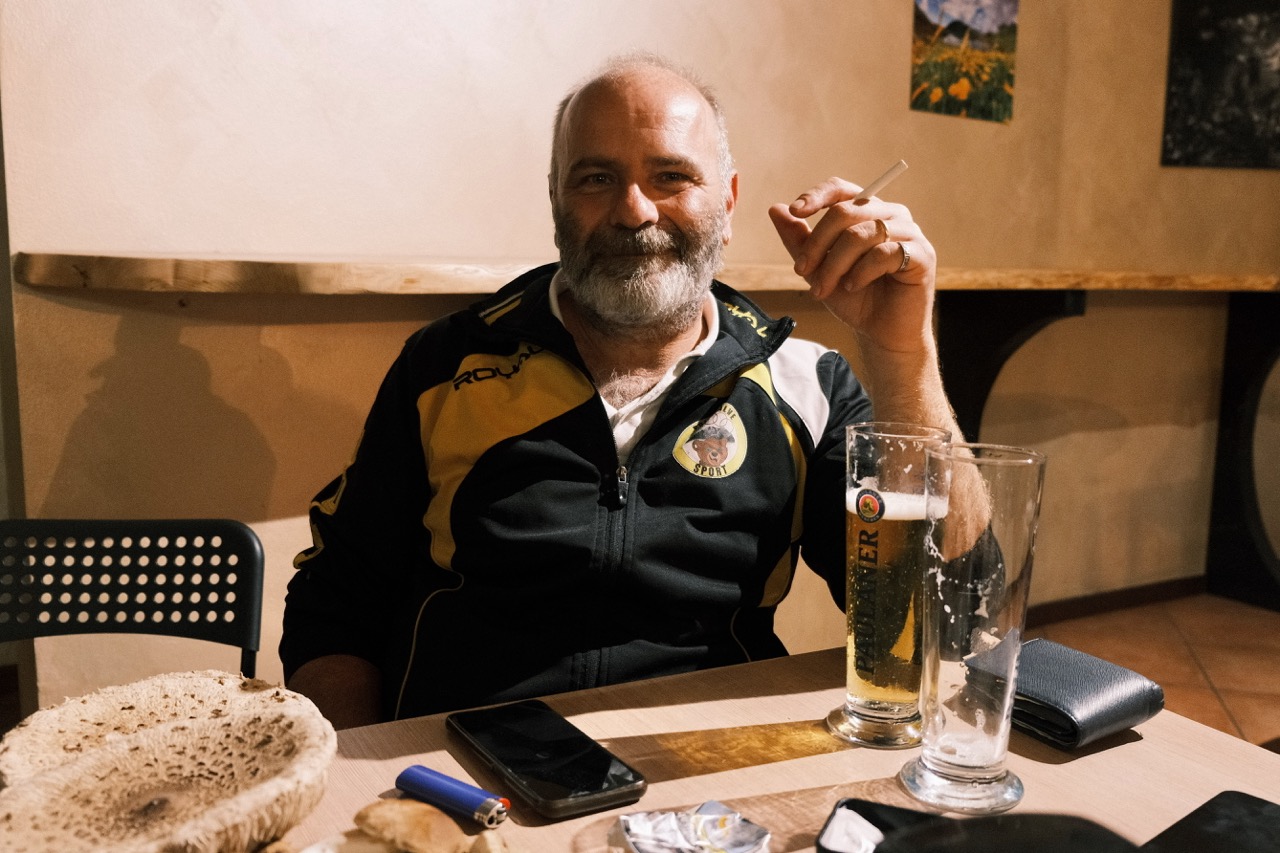
Giampietro gazing toward the Orobic peaks from his kiosk in the gorge below the dam – Photography by Francesco Danesi della Sala
Back in the village, we meet up again with Stefano, this time accompanied by the mayor, Pietro Orrù. He invites us for a friendly chat, and we take the opportunity to get a clearer sense of local life. Compared to other marginal and mountain areas, Orrù explains, employment in Vilminore and the valley is actually very high: nearly 97% of residents work locally, especially in manufacturing. However, several issues common to Italy’s aree interne (inner areas) remain pressing: distance, the dismantling of public services, access to healthcare, demographic decline. In the long term, he admits, it is difficult to imagine the region’s future. «We need young people, we need people to come here and imagine building a life here, it can be done! If you come, I’ll find you a job, that’s guaranteed!» he exclaims emphatically.
Stefano buys us a drink at the ‘mining’ bistro—as the sign at the entrance reads—just a few metres from the town hall. Speaking about mountain life, he notes that tourism has grown remarkably here in recent years. In the year marking the centenary of the disaster, over twenty thousand people visited the dam—something unthinkable just a decade earlier, he stresses.
It’s a complicated relationship, he admits: «You’ve seen the symbol of Vilminore, right? It’s a bear. Well, sometimes we’re a bit like bears, we stay hidden, wary, sometimes we give tourists the side-eye». And yet, he acknowledges, the economic contribution cannot be dismissed. This is why the recent news of a major external project—a plan to create a redeveloped ski resort spanning the Seriana and Scalve valleys[2]—has provoked anything but a unified reaction within the community. On the matter, Stefano prefers not to rush to judgment: «Favourable, yes, but not to the point of ruling out doubt, which helps me to think» he says with a smile.
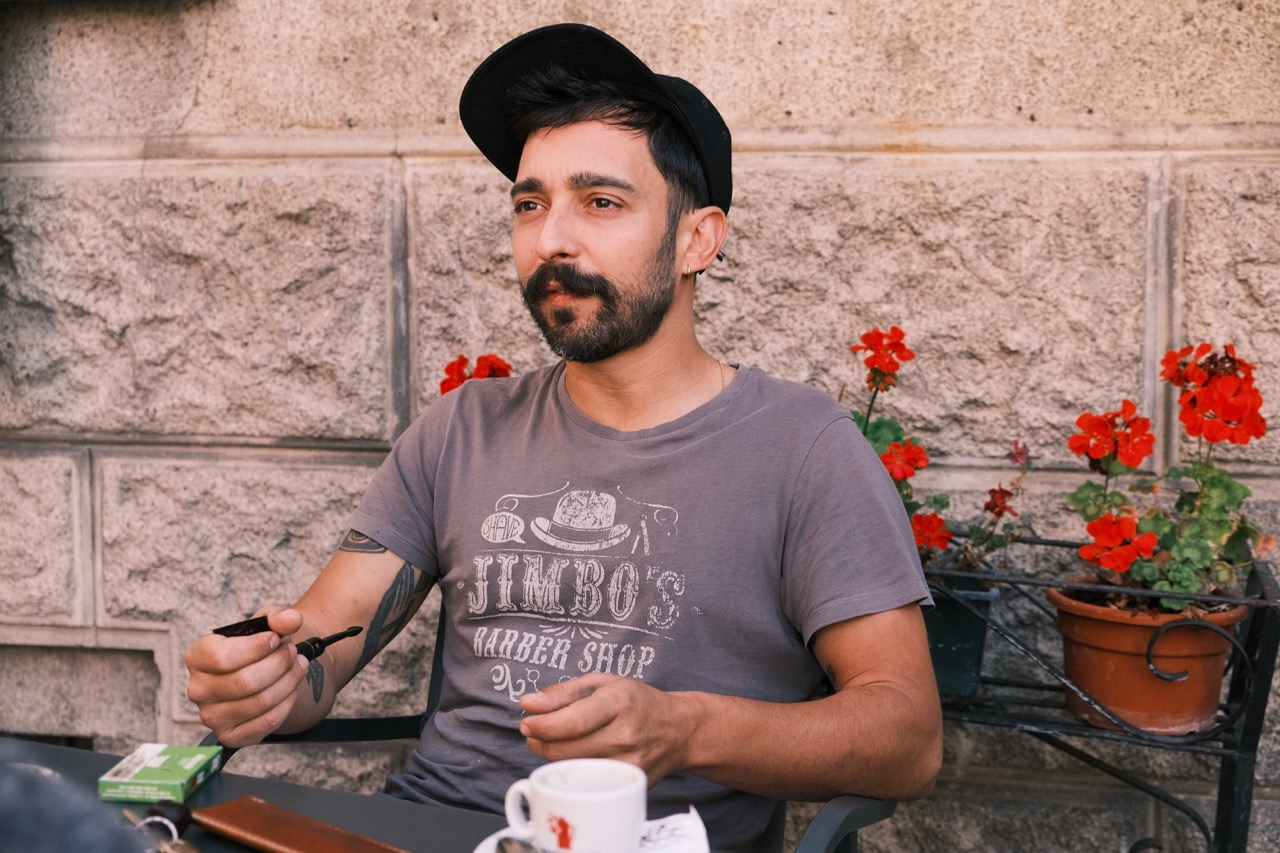
Andrea, the young owner of the small pizzeria Ol Fùren, overlooking the main square of Vilminore – Francesco Danesi della Sala
Evening falls, and on Giampietro’s recommendation we head to the small pizzeria Ol Fùren in the village square. Andrea, the owner, welcomes us with cheerful warmth, his quick speech framed by two thick, old-fashioned black moustaches. After hearing the reason for our visit, he invites us for a chat at the Bar Sport over an unexpected glass of spuma (a decidedly retro soft drink). Andrea, in addition to being a baker, is a keen connoisseur of local stories and traditions—a passion he shares with his ‘mentor’, Sergio Piffari, whom we had already met. On the subject of the disaster, his view is clear: «There are many ways to tell a story. The risk is being crushed by the event». So, he continues, this story must be told in relation to the present, as an entry point into a rich social and cultural territory, with its own complexities and nuances, drawing on the past as a way to critically read contemporary life. «Sharing this place with others, for me, is something beautiful» he explains, «but there’s a balance to maintain» he adds, referring to mountain tourism. The thorny issue, when thinking about the relationship between past and present, remains that of subalternity, and the inevitable ‘blackmail’ it generates: yesterday, the dam’s promises of modernity and work; today, the much-awaited “salvation” of the mountains. Relations shaped by outside interests and by failed ideologies of growth, we add, implemented through industrial, extractive ecological models geared toward profit at the expense of local integrity. «I believe very strongly that nature sets the limits of what can and cannot be done» Andrea counters. And when asked about the ambitious new ski-resort project, he answers firmly: «I don’t believe tourism stops depopulation. The mountains can’t be adapted into an amusement park. The mountains belong to everyone, they’re not private property».
The Mine
Following Sergio Piffari’s advice, we decide to make a stop at the mines of Schilpario. The site was shut down in 1972, when the extraction of siderite—an iron-rich mineral—was discontinued by the Barisella Mining Consortium, partly due to the drop in demand for raw materials and partly because of rising extraction costs. «You know» Sergio explains, «when there was a war somewhere, they hired lots of workers because they needed iron for the cannons. When there weren’t wars, the number of workers went down. They stopped using the mines here, but there’s still a huge amount of ore inside, already quarried. They shut it down because they could bring it in more cheaply from China or Argentina.”
The mines, now silent, were relegated to the underground dimension of the Scalve Valley. A vast submerged world that still unfolds today in a labyrinth of tunnels, shafts where iron ore was stored, and vertical galleries connected by wooden ladders that allowed miners to move from one level to another. A lived-in space: cold, narrow, harsh. Here, generation after generation of scalvini laboured through exhausting shifts, transforming the valley’s subsoil into a raw material that rose to the surface packed into small wagons, which were then hauled to the processing yards before continuing on to the large factories of Breda and Falk in Sesto San Giovanni, on the outskirts of Milan. Abandoned by global markets and by the steel industry, it fell to the community’s memory to keep those tunnels—and the stories they contained—open. A collective memory that, in 1998, was finally given institutional form through the establishment of the Andrea Bonicelli mining park[3].
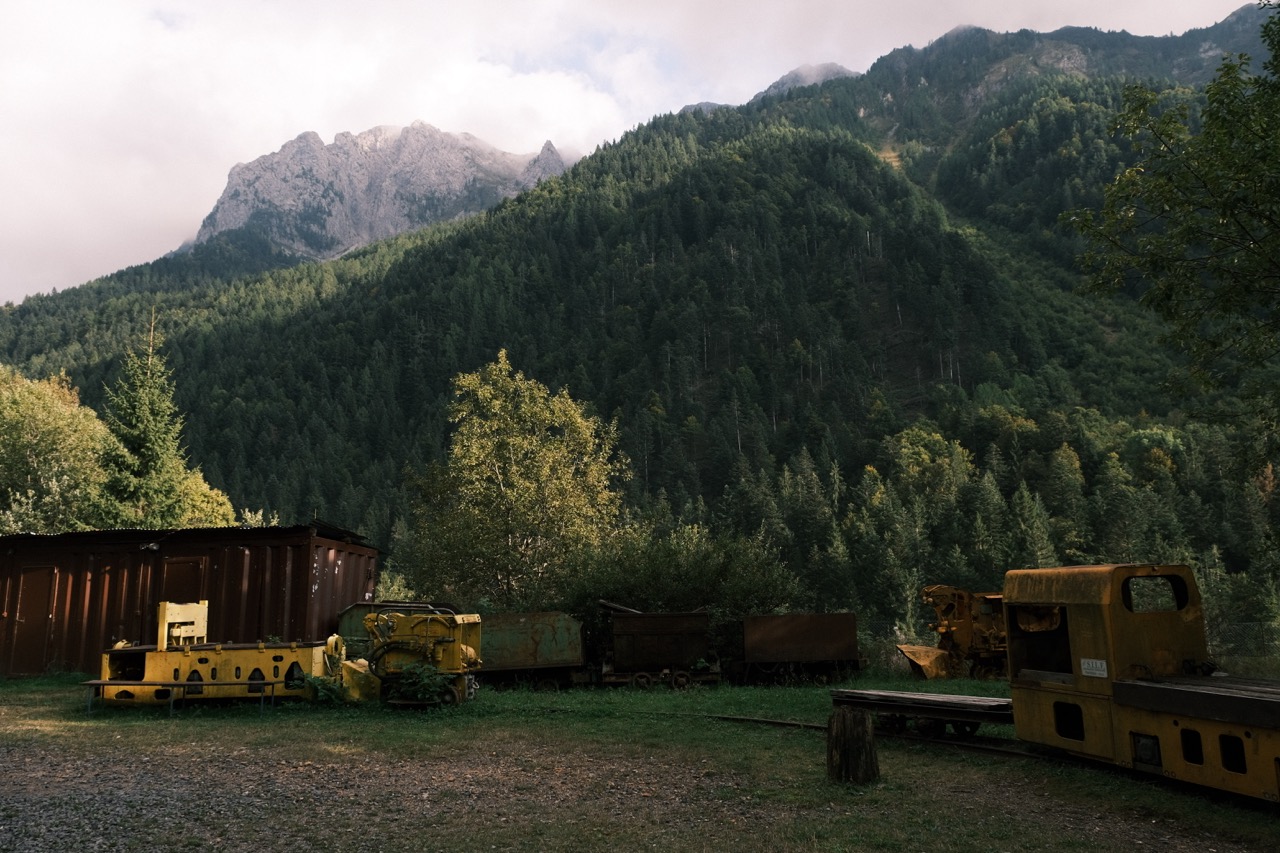
The mines of Schilpario and Mount Gaffione in the background – Photograph by Francesco Danesi della Sala
When we arrive, the site is closed. Yet the absence of tourists or school groups allows us to wander through the forecourt before the gallery entrances, wrapped in a surreal silence broken only by the wind shaking the crowns of the Scots pines that cover the slopes of Mount Gaffione. The wooden sheds where miners rested after their shifts are still standing; places where they might eat a meal or smoke yet another cigarette while the small trains loaded with siderite, or with their fellow workers, rattled in and out of the mountain’s frozen belly. At the height of extraction in the postwar years, the site produced about 300 tonnes of raw iron, extracted by roughly 200 miners. Historically, however, mining work was not carried out by men alone. Women workers were present as early as the 19th century, primarily engaged in the transport and preliminary processing of the raw material, which they split open to separate the iron-rich portions from the rocky residue. Children, too, were involved in mining labour, as documented by the 1839 Deputazione di Schilpario document on child labour. Their shifts lasted twelve hours, divided into eight daytime and four nighttime hours spent breaking stones that miners brought to the yard for sorting. This shared labour accumulated in the valley’s subsoil, shaping their bodies and often condemning them to an early death from silicosis, a lung disease caused by the inhalation of crystalline silica dust[4]. Sergio’s words echo back to us: «I remember when I was a kid, you’d see these poor souls coming out, unrecognizable, covered in dust, and most of it they had swallowed too. Many died, even young. People knew about the health impacts, but there wasn’t much choice. You had to accept it».
In a corner of the forecourt stands a corroded iron archway, beneath which a stone slab holds several photographs of deceased miners. A white hard hat, worn and warped by humidity, swings from a metal hook at the centre of the arch. It is a memorial to those who passed through those tunnels, who inhabited the mountain’s underworld, forced there by an extractive economic system that first condemned them to the mines and then abandoned them, leaving behind yet another spectral zone. In some ways, Val di Scalve’s mining past unsettles the perception an occasional visitor might have upon arriving in its high basins, perhaps expecting a mountain community isolated and fiercely protective of its autonomy. Instead, the mining park tells another story: one of global connections forged through extraction and the circulation of iron. A material sought after since Roman times, then by the Venetian Republic, which in the modern era dominated the valley, and later by the various companies and multinational firms that turned the exploitation of Scalve’s deposits into one of their sources of profit.
The Valley
The Valley is not immobile, nor suspended outside of time. It is a multidimensional territory inhabited by communities that, time and again, have been forced to reckon with development models conceived elsewhere and imposed through violence or economic coercion. Against these incursions stand the cooperative experiments linked to dairy production: a clear expression of the intercommunal forms of sociality through which Val di Scalve has long sought to build a shared system, moving beyond parochial divisions and sectarian rivalries. These experiments are woven into local identities and histories, beginning with the creation of the so-called latterie turnarie, the rotating dairies whose distinctive features Valentina—the veterinarian from Vilminore—describes to us with unfiltered enthusiasm: «Back then, there was a cheesemaker who would collect my milk, your milk, and his milk, and with an incredibly ingenious system would keep track of how much each of us had delivered. It’s not like he paid you in money. Once you reached the amount needed to make a formaggella, he would give you the cheese. Or butter». A system of reciprocity, exchange, and mutual support, and one, Valentina explains, that relied on a rather curious recording tool: «They had a cherry or hazel stick, marked at the top with something personal—a little bell, initials, a ribbon. The whole stick was notched: one mark for each delivery, and then another kind of notch, like a credit ledger». Over time, the latteria turnaria evolved into a full-fledged social dairy, organized as a cooperative enterprise. Lorenzo Bruschi, its current director, speaks of it with pride: «It’s a cooperative made up of sixteen cow-milk producers and four goat-milk producers, all from Val di Scalve». Originally from Sesto San Giovanni (on the outskirts of Milan), Lorenzo readily admits he does not feel Scalvino: «I’m a Milanese who moved to Val di Scalve. And I’m not offended when they say so, they don’t consider me Scalvino, and they’re right. You have to learn how to live together». But the social fabric of the valley is shaped by more than the dairy. Today, Lorenzo notes, the sports club Poliscalve is able to bring together sports and volunteer work across all the Valley’s municipalities in unprecedented ways, revealing what he calls the beauty of «the valley’s social side».
Lorenzo, director of the Val di Scalve social dairy, which brings together cow- and goat-milk producers from across the valley – Photograph by Francesco Danesi della Sala
Yet these experiments also stand in contrast with the shadow of conflict and fragmented visions, due in part to a form of self-representation that seems to highlight divisions between the valley’s various communities. «Parochialism exists, of course it does» Lorenzo reflects, now thoroughly attuned to the valley’s cultural dynamics. «Some things get passed down from way back. On certain issues, the Valley is divided». And yet, the absence of a broader shared identity—of a real imaginary totality in which to recognize oneself—may actually represent a horizon of possibility, a space for social creativity waiting to be rebuilt from the ground up. One that begins with mutual recognition of the Valley’s common history, a history that has shaped both the territory and those who inhabit it. A history that should not dictate the Valley’s future, but simply remind its people that collective dialogue and cohesion can prevent this place from being moulded and bent to ambiguous interests. Interests that inevitably wound both the land and those who live upon it.
ABOUT THE AUTHOR
Francesco Danesi della Sala holds a PhD in Cultural and Social Anthropology. His research focuses primarily on environmental issues and the climate crisis. He has conducted ethnographic fieldwork in the seismic crater of central Italy and in the Po River Delta. He serves as editor-in-chief of Alea. In 2025, he published Nature ribelli. Viaggio nella metamorfosi climatica alle foci del Po (Wetlands).
Pasquale Menditto is an anthropologist and holds a PhD in Global Histories, Cultures, and Politics and Ethnoanthropology from the University of Bologna. He has carried out fieldwork in France, Italy, and Lebanon on refugee-related issues. He is currently an independent researcher (a.k.a. unemployed), trying to figure out what to do with anthropology outside academia.
[1] Beginning in 2013, Italy introduced a National Strategy for Inner Areas (Strategia Nazionale per le Aree Interne), aimed at marginal and peripheral localities requiring targeted territorial revitalization policies. The classification of an ‘inner area’ depends on several criteria: accessibility to primary public services and infrastructure, proximity to public healthcare facilities, the possibility of accessing secondary education, and the availability of mobility infrastructures. The major challenges facing these areas include socio-economic marginalization and depopulation.
[2] This refers to the ‘Colere–Lizzola’ project which, according to its private promoters—supported by substantial public funding—is proposed as a tool to revive the local economy and counter depopulation. This «assault on the highlands» to use the expression of journalist Andrea Siccardo, who reported on the issue for Altreconomia, would materialize through the expansion of the local ski area, involving the construction of new lifts and the excavation of a tunnel between Val Sedornia and Val Conchetta, two wild, still uninhabited zones.
[3] Bonicelli was the engineer who supervised the work of the Barisella Mining Consortium in the post-war years, when Marshall Plan funds financed the industrialization process of the newly born Italian Republic, then a strategic ally of the United States in the midst of the Cold War. The archaeological park is accessed through the Gaffione mining site, located a short distance from the town center of Schilpario.
[4] Silicosis, along with tuberculosis, was one of the defining diseases of the Second Industrial Revolution, marked by heavy industry, metalworking, and steel production. Until the 1930s, there was no real legislation protecting those working in mines. The issue was first addressed technically in the late nineteenth century with the introduction of a water-powered drill that moistened the rock surface during drilling, reducing the production of ‘heavy’ dust. However, its international adoption remained discretionary, and silicosis itself was barely recognized as an occupational disease.